

OSAB 7-minute briefing: interpretation support and services
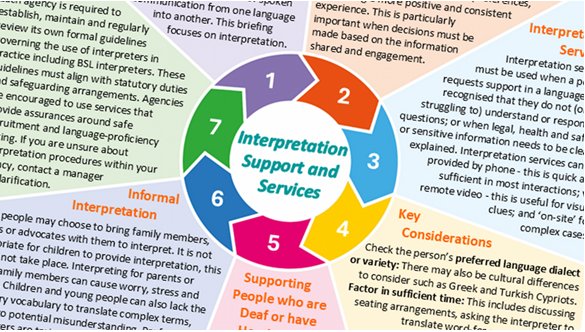
Oldham Safeguarding Adults Board (OSAB) are pleased to share the next 7-Minute Briefing in a series focused on supporting people with a range of access needs. The new briefing is all about interpretation support and services.
The briefing defines interpretation and translation; explains the importance of supporting people who speak different languages and when to use interpretation services; provides some key considerations for practitioners when interpreters are used; and guidance around informal interpretation.
7-Minute Briefings are based on research which suggests that seven minutes is an ideal time span in which to concentrate and learn. Learning for 7 minutes is manageable in most services and often more memorable as it is necessarily brief and not clouded by other issues and pressures. These short, safeguarding snapshots can be a helpful way to support team learning. Please discuss this briefing within your teams, complete the OSAB 7-Minute Briefing Team Discussion Feedback Form to record and evidence how you have used the briefing and send a copy to OSAB.
Forced marriage and so-called honour based abuse: strengthening awareness
Forced marriage and so-called honour based abuse continue to be significant safeguarding concern, affecting people of all ages, genders and backgrounds. Practitioners across Oldham play a vital role in identifying early warning signs and ensuring individuals at risk receive timely and safe support.
To help practitioners recognise and respond to concerns, Oldham Safeguarding Children Partnership (OSCP) and Oldham Council have produced a short video. It explains what forced marriage and so-called honour based abuse are, the key signs to look out for, and how to respond safely when concerns arise.
There is an opportunity for practitioners to strengthen their knowledge through the upcoming in person so-called honour based violence and abuse training. The session is designed for all professionals and offers practical guidance on risk, the “One chance rule”, and how to respond effectively to safeguarding concerns.
Training details: 15 June 2026, 9:30-16:30 at Rock Street Resource Centre, Oldham OL1 3UJ. Places are limited to book a place, please email oscptraining@oldham.gov.uk
NEW! OSAB gab podcast episode - hoarding lived experience
Listen: Apple Podcasts, Spotify, Amazon Music and RSS.com or search for 'OSAB Gab' wherever you get your podcasts.
In this brand new episode, we hear directly from Lesley and James, two people from Oldham who generously share their lived experiences of hoarding. Their personal stories bring the realities of hoarding behaviours to life in a way that only lived experience can, offering insight and a deeper understanding that goes far beyond theory.
Representatives from partner agencies across Oldham reflect on the powerful themes raised by Lesley and James. They explore why it’s so important to understand a person’s life history and circumstances, and how these may connect to their hoarding behaviours. The episode highlights the importance of practical, compassionate approaches such as using the same language the individual uses to describe their belongings and working alongside them at their own pace to build trust, relationships, and long‑term progress.
This is an honest, insightful conversation that shows how lived experience can shape better practice, deepen understanding, and remind us of the humanity at the heart of hoarding support.
Associated Resources:
- OSAB & OSCP Responding to Hoarding Guidance
- OSAB Trauma Informed Practice Guidance
- OSAB Tiered Risk Assessment and Management (TRAM) Protocol
- Oldham Hoarding Peer Support Group
Cultural competence in safeguarding
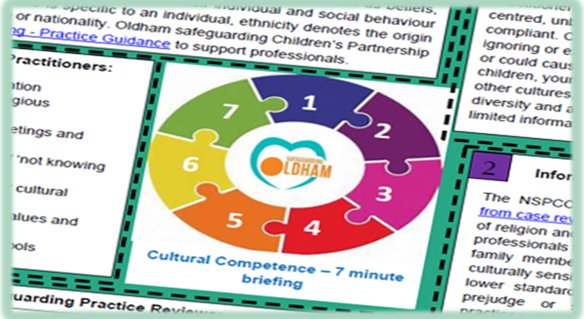
Cultural competence is essential to delivering safeguarding practice that is fair, equitable and respectful. It involves the skills and awareness needed to communicate and work effectively with people from all cultural backgrounds. Culture reflects the beliefs, values and worldviews that shape a person’s identity, and is distinct from ethnicity, which relates to heritage or group affiliation.
Learning from the recent Local Child Safeguarding Practice Review into the tragic death of Sara Sharif (2025) reinforces why cultural competence must remain central to safeguarding practice. The review highlights the importance of practitioners recognising cultural influences without making assumptions, and ensuring that assessments, decision making and communication remain child centred and evidence based.
Professionals can access the full 7 minute briefing and further guidance on the OSCP website.

New hub of helpful resources for adult survivors of child sexual abuse
The Centre of Expertise on Child Sexual Abuse have launched a new hub of helpful resources for adult survivors of child sexual abuse, which brings together vetted and reliable resources in one freely accessible place.
The new hub acts as a directory to help users find a variety of externally hosted resources by trusted sources in a range of formats. This hub of helpful resources aims to make it easier for adult survivors to find information that meets their specific needs. Self-help resources are not a substitute for specialist support, but they can help people to understand what they are going through, feel less alone, and build skills that support healing and recovery.

Child employment – do you know the law?
It is child employment month in April. Did you know that children and young people aged from 13 until they leave secondary school require a work permit to be employed? Not many people do, however the legislation has been in place since 1933! This applies even when they are 16 but still in year 11. There are certain types of employment children can do along with restricted hours to ensure their wellbeing that provides them with the opportunity and experience of working. This statutory requirement is an essential part in ensuring that children are appropriately safeguarded/protected whilst in employment.
There is more information available via the NNCEE National Network for children in employment and entertainment however it is the Local Authority who have responsibility for the licensing of children of compulsory school age. Children who are part of the entertainment industry require a different type of licensing, access the links for more information:
New OSAB homelessness awareness training
A new OSAB training course has been developed to equip practitioners with knowledge and awareness of homelessness legislation and the process a customer would experience should they approach the Council’s Homelessness Services. It will be delivered by members of Oldham Council’s Housing Options team on 16 April 2026.
By the end of the session, participants will understand:
- The statutory duties the Local Authority have to a person experiencing homelessness
- The needs and risks considered within Homelessness assessments, determining priority need
- Details about working in partnership and when to refer to adult safeguarding.
Take a look at the OSAB website for more information including how to book your place.
Closure of Samaritans’ email and letter-writing services
Samaritans is closing its UK email and letter writing services in 2026 but will continue to offer immediate support for anyone in crisis through its 24/7 telephone helpline.
Please remove any signposting within your agency to the Samaritans’ email address “jo@samaritans.org” and to the letter writing service “Freepost SAMARITANS LETTERS.” This includes any posters, leaflets, webpages, internal guidance, training materials, or automated communications that may still reference these options.
You should continue to signpost to the Samaritans’ 24/7 telephone helpline, using the suggested message below:
When life is difficult, Samaritans are here to listen – day or night, 365 days a year. No judgement, no pressure. You can call them for free on 116 123 or visit www.samaritans.org
The way people seek support is changing and the closure of these services is part of Samaritans’ efforts to make sure its services are fit for the future. Alongside prioritising the 24/7 telephone helpline, the charity is working to expand its online chat service – currently available six nights a week. Through the telephone helpline and online chat service, Samaritans’ trained volunteers will continue to provide immediate support for anyone in crisis.
To find out more please visit Samaritans' website